3D Printed Pet Figurine Materials: Resin, PLA, PETG and More
Compare resin, PLA, PETG and other options for a custom pet figurine, and learn what to ask about detail, finishing, fragile features and display conditions.
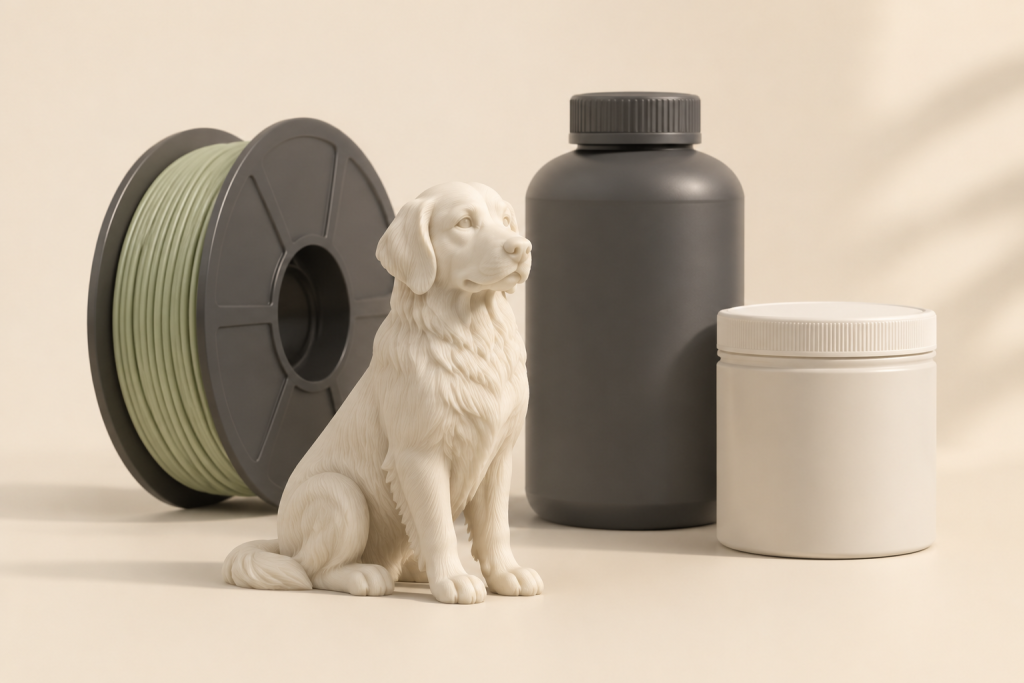
Prepared with AI assistance and reviewed for publication. Illustrations are identified separately.
For a small indoor figurine where fine features and a smooth-looking surface matter, resin photopolymer printing is worth asking about first. PLA or PETG filament may suit simpler shapes or other priorities, while powder-based nylon is another process to discuss for some complex forms. These are general tendencies, not a head-to-head test: the exact material, model design, print orientation and finishing all affect the result. A material name alone cannot promise that delicate ears or tails will survive handling.
Material and printing process are different things
FDM prints by extruding thermoplastic filament, such as PLA or PETG. SLA cures liquid photopolymer resin with light. SLS uses polymer powder, commonly nylon. These process names are not material names, and each process has its own surface and post-processing considerations.
Also keep ABS-like resin separate from ABS filament. ABS-like is a name used for some photopolymer resin formulations; it does not mean the product is the same material as thermoplastic ABS filament.
References: ELEGOO: ABS-like Photopolymer Resin V3.0; Formlabs: FDM vs. SLA vs. SLS; Formlabs: 3D Printing Miniatures and Custom Figurines
Resin: consider it for fine indoor display details
SLA resin printing is generally suited to small, detailed forms and can produce a finer-looking surface than typical FDM printing. That is a process-level tendency, not a guarantee for every figurine: orientation, supports, surface treatment and the particular resin all matter.
Ask how supports are removed and what surface preparation is included before painting. Support marks may need attention, and painting is a separate finishing step, not an automatic property of the resin; ask separately whether any protective coating is included.
“ABS-like” describes a resin formulation category in some product ranges. Different formulations have different design goals, so the name alone does not establish how a thin tail or ear will perform. Ask about those features and how the finished figurine should be handled and displayed.
- Worth considering when small sculpted details and an indoor display finish are priorities.
- Ask whether the quoted finish includes support cleanup, sanding, primer, paint and surface protection.
- Do not infer that a delicate part is impact-proof from the word “tough” or “ABS-like.”
References: ELEGOO: ABS-like Photopolymer Resin V3.0; Formlabs: 3D Printing Miniatures and Custom Figurines
PLA: a filament option for simpler forms and concepts
PLA is a common FDM filament that is relatively easy to print and can show detail. FDM layer lines are often more visible than on SLA prints, although the outcome depends on the model and finishing; it is too broad to say that every filament-printed figurine looks rough.
PLA can be a candidate for a simplified design or concept model. Its heat, UV and toughness limitations are reasons to ask where the maker recommends displaying the finished piece. There is no universal temperature or durability promise that follows from the material name.
- Ask to see a close-up of a comparable finished print, especially around the face and other fine features.
- Check whether visible layer lines will remain, or whether sanding, primer and paint are part of the finish.
- Avoid assuming that PLA is suitable for a sunny window or warm display spot without the maker’s guidance.
References: Prusa: PLA Material Guide; Formlabs: 3D Printing Miniatures and Custom Figurines
PETG: consider the trade-offs, not just toughness
PETG filament is often considered when toughness or functional performance is a priority. Its printing trade-offs can include stringing, challenges with overhangs or bridges, and detail limitations that may matter for a highly detailed figurine. Results vary with the formulation and printing conditions.
A general reputation for toughness does not guarantee that a particular thin ear, leg or tail will resist breakage. Ask the maker how those parts are designed and protected in transit, and request evidence if a specific durability claim is made.
- Potentially worth discussing when structural toughness is a priority.
- Ask what detail and surface finish to expect on a figurine of similar size.
- Do not treat the material name as a guarantee against breakage or heat-related changes.
References: Prusa: PETG Material Guide
Other options: ABS and ASA filament, or SLS powder nylon
ABS and ASA are thermoplastic filaments, not photopolymer resins. ASA is used in some outdoor and technical applications and has an advantage over ABS in UV resistance, but that does not make a painted figurine automatically suitable for long-term outdoor display. Paint, coatings, adhesives and the base may have different limits. For ASA, chemical smoothing can soften fine details and sharp edges.
SLS powder nylon is a separate process from FDM nylon filament. Unfused powder supports the print during production, but the part still needs powder removal. The surface can have a grainy feel unless further finishing changes it. It may be an option to ask about for complex forms or durability needs, but that does not establish that it will give the best detail or surface for a small pet likeness.
- Clarify whether a maker means ABS or ASA filament, ABS-like photopolymer resin, or SLS powder nylon.
- For an outdoor display, ask about the entire finished object, not just the raw material.
References: ELEGOO: ABS-like Photopolymer Resin V3.0; Formlabs: FDM vs. SLA vs. SLS; Prusa: ASA Material Guide
Choose for the finished figurine and its display
Start with the features you care about: fine facial detail, a particular surface finish, simplified styling, or a design with slender parts. Then discuss the whole production and finishing plan. A model’s structure, scale, print orientation and post-processing can change the outcome, so material comparisons are only a starting point.
For any option, treat the figurine as a decorative keepsake rather than a chew toy or children’s toy. Do not infer that a material is suitable for chewing, food contact or children simply because it has a familiar name or has been fully cured. The information here is general buying guidance, not a guarantee about an individual piece.
References: Formlabs: FDM vs. SLA vs. SLS; Prusa: ASA Material Guide; Prusa: PETG Material Guide; Prusa: PLA Material Guide; Formlabs: 3D Printing Miniatures and Custom Figurines
Questions to ask the maker before choosing
These questions help turn a broad material comparison into a clear brief. Ask for specific answers about the proposed figurine and finish; do not assume that a general material description confirms how a particular piece will look or hold up.
- What is the exact material brand or type, and what printing process will be used? If you hear “ABS-like,” is that photopolymer resin or ABS filament?
- Can I see close-up photos of unpainted and painted examples with similar size and detail? Ask whether the images show the same process and finish being proposed.
- How are small features such as ears, tails and legs designed, and how will the figurine be protected during shipping? If a durability claim is important, what actual verification supports it?
- What primer, paint and protective finish will be used, and what display conditions does the maker recommend?
- What does the quote include: cleanup, sanding, painting, surface protection, a base and packaging?
Sources and references
- ELEGOO: ABS-like Photopolymer Resin V3.0 — accessed 2026-11-06
- Formlabs: FDM vs. SLA vs. SLS — accessed 2026-11-06
- Prusa: ASA Material Guide — accessed 2026-11-06
- Prusa: PETG Material Guide — accessed 2026-11-06
- Prusa: PLA Material Guide — accessed 2026-11-06
- Formlabs: 3D Printing Miniatures and Custom Figurines — accessed 2026-11-06